
Saturday Jan 3rd, 2026
Full Moon in Cancer
5:03 am EST
Capricorn, the sign always in opposition to a full moon in Cancer carries themes of stability, hard work, security and foundation. Capricorn is a sign that's in it for the long-haul - maybe more in terms of the tangible earthly reality, though Capricorn is also a sign of liminality. This is because - with Saturn as it's ruler it is a sign that can signify death, limits and endings etc. So Capricorn has this quality of being neither here nor there. . Symbollized by the sea-goat, It is of the land but it is also of the sea. It is in-between. It has this quality of being grounded yet also mystical and other-worldly.
In death (from my vantage point) there is also ever-lasting life. Yes, there is the solidity of separation from our bodies but there is also an opening to a greater spiritual reality beyond death, aka the continuation of life.
Death comes with loss and separation but it also comes with deeper connection to our truest selves, to our spiritual nature - to that aspect of us that moves through eternity and carries the wisdom of greater consciousness.
In Buddhist circles there’s this idea of everyone having been a kind mother to us in a past life. This is more where the notion of Cancer as an archetype comes in. Cancer is about connection, it's about comfort and care, the nourishment of emotional intimacy, between a mother and child, between life and death and creation itself, between friends and even between strangers ~ where there can be familiarity on a soulful level.
In buddhism, there is also this idea of the mother luminosity.
To understand the mother luminosity, we first have to understand the child luminosity.
Pema Chodron describes this relationship in her book "How we live is how we die".
In this book, she shares with us that "a traditional way of describing the final dissolution of this life-consciousness dissolving into space- is in terms of the "child luminosity" meeting the "mother luminosity". The child luminosity is the experience of our minds' sky-like nature, with which we can familiarize ourselves through training. In the Tibetan Buddhist tradition, a teacher points out this nature to a student and gives the student instructions on how to cultivate and stabilize the experience of wide open, unfettered mind. These teachings and practices are all designed to develop confidence in the child luminosity. This is how Mingyur Rinpoche had spent many years of his life, and this is why he was so prepared to die.
The mother luminosity- also known as the "ground luminosity"- is the ultimate nature of reality, which is no different from our own nature. It's the infinitely open space of awareness that encompasses everything and everyone. It's the basic goodness of the universe, imbued with compassion and wisdom. And what I find so inspiring is that people like you and me can always connect with it.
Yet, although it's continually present, it is only fully and completely revealed to us at the end of the dissolution process- and only then if we can recognize it.
When we've prepared ourselves well by training in the child luminosity, we will recognize our mother when she shows her face. Then, like a small child who has been with a babysitter all day, we will naturally run to our mother to become reunited with her. As it says in one of the prayers about the bardos that I often recite "May I be liberated, as naturally as a child running to it's mother's lap".
The child luminosity can be compared to the space inside a vase and the mother luminosity to the larger space outside. Though the inner and outer spaces are separated by the vase and we can talk about them as if they're two different spaces, their essence is exactly the same. Both are simply space. When the vase breaks - analogous to death - the barrier between the two spaces disappears and they merge into one.
When we use the term "luminosity" to talk about our mind's nature, we're not talking about something like ordinary light. Luminosity is the quality of our mind that is aware. It is that which knows. It's how we know what we're seeing and hearing and thinking and feeling, and it's how we have the potential to know our own true nature. Maybe it's more helpful to simply call it "open awareness" something we can practice and connect with.
If we familiarize ourselves with the continuous flow of births and deaths, the continuous bardos that make up our life, we can gradually over time come to see that this awareness is the background of every experience.
We can get to the point where open awareness accompanies us through every beginning and every ending, through every up and every down. It doesn't appear and disappear. It's there in all the transitions and gaps. It's a permanent feature of our mind's landscape. This may seem far off right now, but it's our birth right, an always beckoning possibility. " ~ Pema Chodron
Sometimes this is how I see Cancer and Capricorn interacting, like feminine & masculine, like yin and yang. Both are contained within each other, there’s no way to separate either from the other really. Instead of relating to these archetypes as opposites, as Thich Nhat Hanh would say, rather they inter-are. Like the child and mother luminosity, they are inseparable and intimately tied together. The ocean contains the drop and the drop is still water, even when it dries up, it doesn't cease to exist, it just becomes something else.
"The cloud becomes rain, becomes grass, becomes tea." ~ Brother Phap Dung
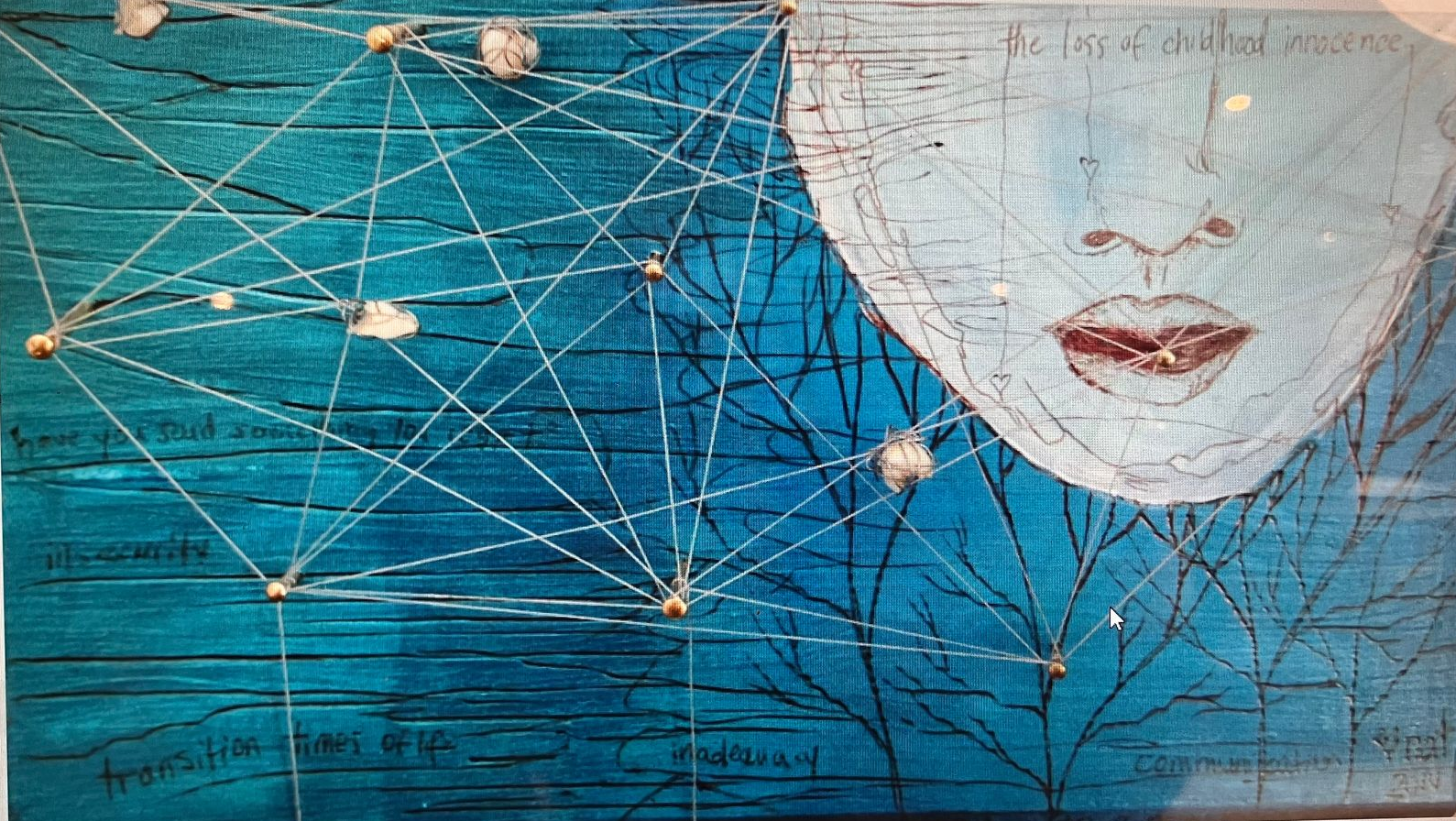
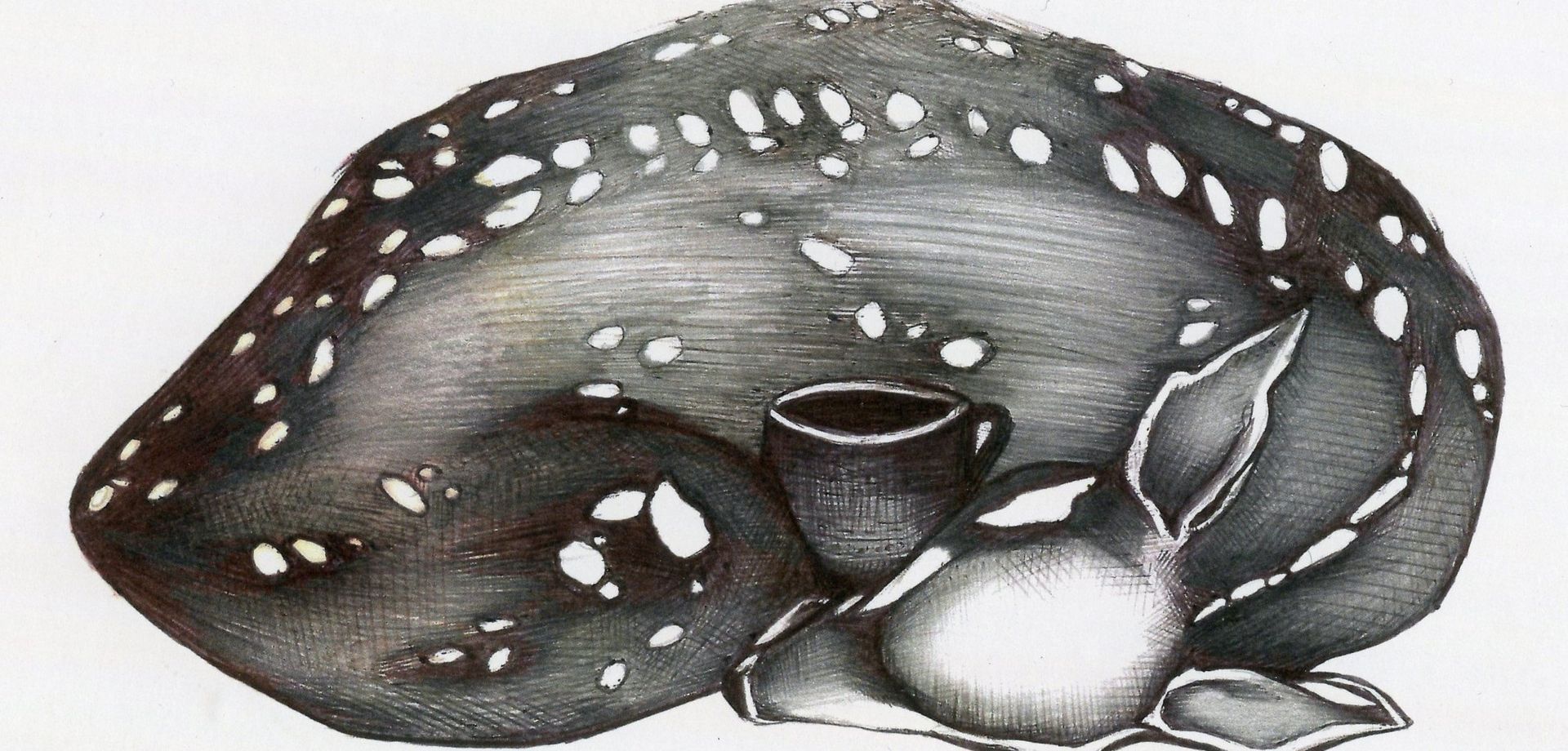
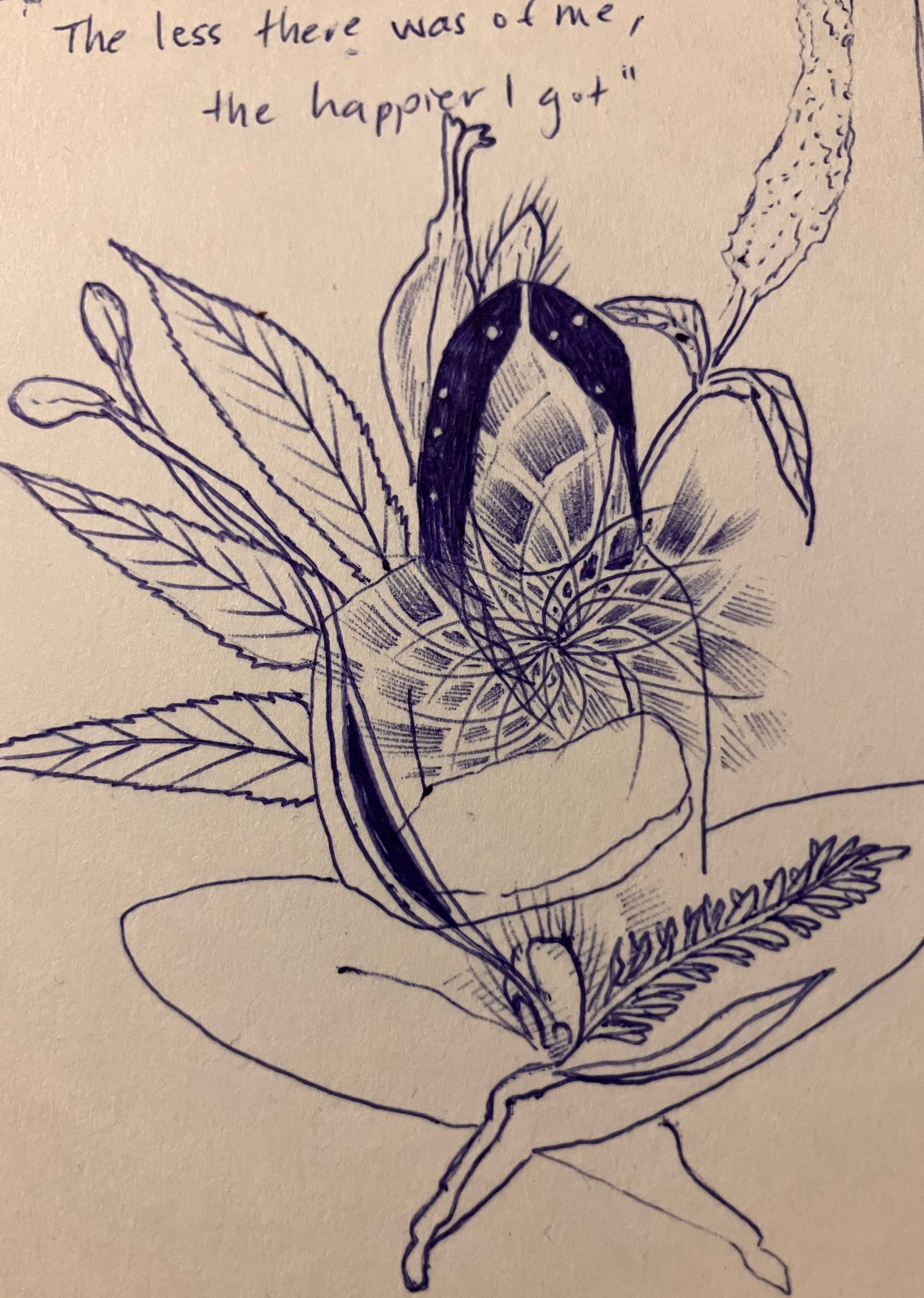
ps. The quote in the image above "the less there was of me, the happier I got". Is a quote by Leonard Cohen which refers to the letting go of ego or small self/personality/our idealized self-image/ambition or any kind of narrative we attribute to our 'self' as a singular entity. This letting go naturally relieves us of a lot of our suffering. Apparently Leonard Cohen said this to illustrate the benefits of many years of meditation.
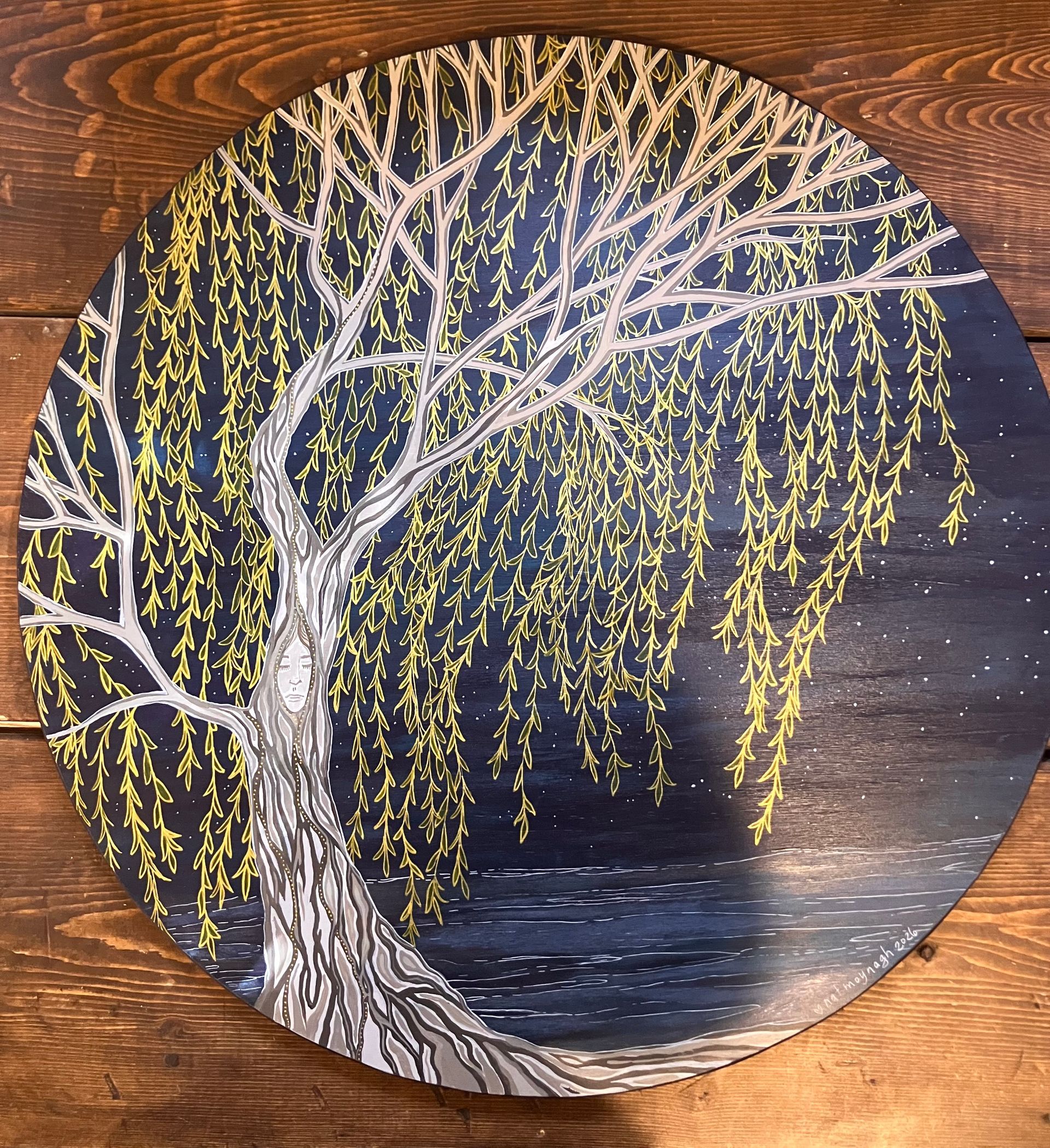
For a stretch of time a few years ago I decided to draw my body everyday representing how I was feeling as someone with an invisible disability. I was wanting to make the invisible visible. Most days this was representative of a lot of pain I was in and words that often reflected what I was carrying. But on this day I felt tapped into something larger than myself- linked to a much more expansive sense of self- to that larger fabric of reality which I know intimately as spirit and this Leonard Cohen quote was lingering with me at the time. It felt like the right image to accompany this little moon update. I was also painting and drawing willows a lot then and learning what their leaves and catkins looked like. Just a little reminder to myself I guess that I am and we all are both spirit and nature.
Why was there a baby? I don't know, maybe you can't even really tell - it looks more like empty space - but the intention was there. I think I was grieving the possibility of being a mother in this lifetime which was something that used to feel really important to me, an experience - a role- an initiation I didn't feel like I could live with out. So maybe it's also representative of that part of me that's been letting go and also imagining and being with my grief in a tangible way, holding that sad part of me lovingly like a kind mother would.
The experience of motherhood was something I wanted deeply but I recognize in myself now that it doesn't make sense for me personally living with chronic pain in the current zeitgeist we're in. My decision to not have children is full of so much love for those beings that could have been if only I had healed enough in time in the "right" way. Instead I tap into something larger to hold me, this grief and this love which fills me with peace and acceptance.
In some buddhist circles, we learn that self-cherishing causes us to suffer (maybe it even causes all of our suffering). This "I" constantly needing so much attention, care, validation, respect etc. It's a stressful way to live. It's a bit of a relief to counter the importance of "I" with the reminder that I'm not that important in reality and instead to sink into how pleasant it is to just be with the mundane, to sink into not needing to be special, to be "somebody", to hit all the marks, or for others to perfectly attune to me/my needs. It's a lot to unlearn and let go of. Maybe an intention best spread out over lifetimes. Not to be solved in any one sitting that's for sure.
In other words, I go to sangha because I suffer in these ways. I forget everyone's happiness matters just as much as mine does and that a lot of my struggles are largely due to my own frame of mind. I mistakenly blame others and get caught up in self-cherishing. Maybe this is why buddhism is a practice, something I keep coming back to, time and time again. It's sort of like being on and off the wagon. That's how I relate to it anyway.
That's all.